Best Dog Food for a Beagle: Budget vs Premium Options
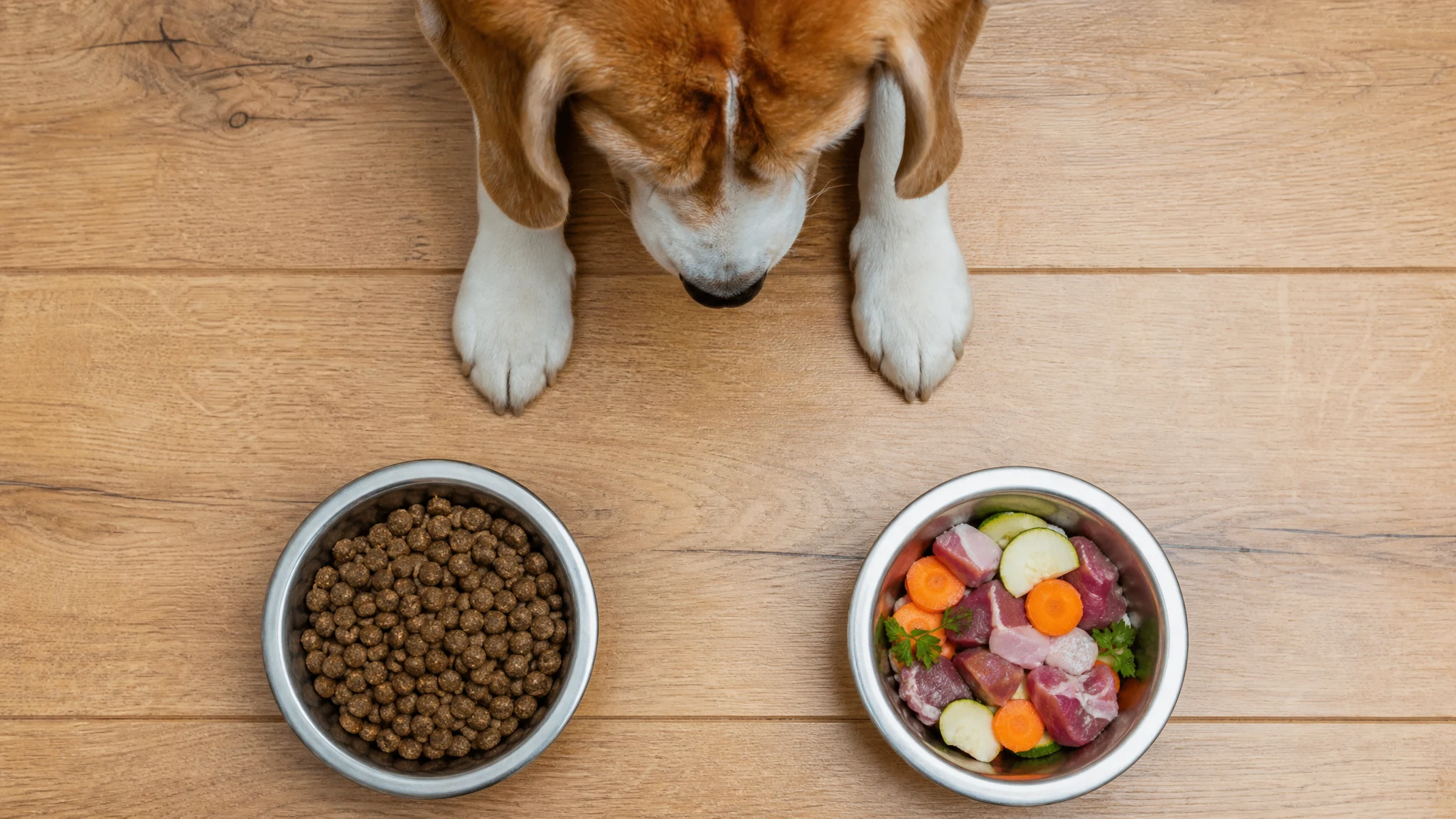
General nutrition information compiled from product labels and published sources, not veterinary advice. Your veterinarian is the right person to choose a diet for your dog, especially one with a health condition.
A Beagle is a small to medium hound, usually 18 to 30 pounds as an adult according to Hill's Pet Nutrition's breed page, though PetMD lists a slightly narrower 20 to 30 pound range. Both sources, along with Royal Canin's breed library, agree on one thing: Beagles are prone to obesity and tend to gain weight easily once they're past puppyhood. That makes the question of which food is "best" less about the price printed on the bag and more about what's printed on the label itself.
This guide walks through how to compare a lower-priced formula against a higher-priced one using only what's on the package: the AAFCO adequacy statement, the life stage, the guaranteed analysis, the calorie count, and the ingredient list. For a side-by-side look at specific products, see this label-by-label comparison of dog foods for Beagles.
What "budget" and "premium" actually mean on a label
We did not collect pricing for this guide, and a food's price tag is set by the brand and the retailer, not by us. So instead of ranking foods by cost, this article treats "budget" and "premium" as two ends of a formula spectrum: simpler, grain-inclusive recipes with broad life-stage claims on one end, and breed-specific, grain-free, or fresh-format recipes on the other. The only way to know which is more or less expensive at a given moment is to check the brand's own website.
What you need before you start
- The bag, can, or pouch of the food your Beagle eats now, or its label photographed or saved
- The label of any food you're considering switching to
- A measuring cup or kitchen scale, since feeding guides are usually printed in both cups and grams
- Your Beagle's current weight, and roughly how active they are
- A few days to a week for a gradual transition if you do switch foods
- Your veterinarian's contact information, for any dog with a diagnosed condition or a puppy still growing
How to compare budget and premium Beagle foods, step by step
Step 1: Find the AAFCO statement first
Before looking at price or ingredients, find the nutritional adequacy statement. It will say the food is "formulated to meet" AAFCO Dog Food Nutrient Profiles, or that it was substantiated through AAFCO feeding tests, for a specific life stage. Royal Canin's Beagle Adult formula, for example, states it is formulated to meet AAFCO profiles for maintenance. Hill's Science Diet lines typically state they were tested through AAFCO feeding trials. If a bag or can doesn't carry this statement anywhere, that is worth noting and asking the brand about directly, since it's the one line that tells you the food is meant to be a complete diet rather than a topper or treat.
Step 2: Match the life stage to your Beagle's actual age
Royal Canin's own product page says its Beagle Adult formula is intended for purebred Beagles 12 months of age and older. A growing puppy needs a food labeled for growth, not maintenance. Some growth and all-life-stages labels carry extra wording about large breeds. Kentucky's pet food regulation, 12 KAR 3:039, which applies AAFCO's standard label language, requires a growth food to state either that it is formulated "including growth of large size dogs (70 lb. or more as an adult)" or "except for" that growth. Since an adult Beagle tops out well under 70 pounds, that particular large-breed wording is not something you need to weigh when choosing a puppy food for a Beagle. It only matters if you're comparing a food meant for a much bigger breed.
Step 3: Line up protein, fat, and fiber side by side
The guaranteed analysis panel lists minimum protein and fat and maximum fiber, as fed. Royal Canin's Beagle Adult lists 25 percent protein minimum and 10 percent fat minimum. Royal Canin's Medium Adult lists 23 percent protein and 12 percent fat. One caveat: Hill's Science Diet publishes an average nutrient table on a dry-matter basis rather than as-fed guaranteed minimums, so those figures aren't directly comparable to a standard guaranteed analysis panel. Treat Hill's dry-matter numbers as a separate kind of figure, not a stand-in for the minimums on another brand's bag.
Step 4: Compare calories per cup or can, not the bag price
A smaller, denser bag can cost less per bag and still cost more per day if the food is calorie-dense and the feeding guide calls for a larger portion. Because Beagles run easily toward overweight, according to Hill's, PetMD, and Royal Canin's breed library, the calories-per-cup or calories-per-can figure on the label matters as much as the ingredient list. Use it alongside the feeding chart printed on the package as a starting point, then adjust based on your dog's actual body condition.
Step 5: Read the first five ingredients
Ingredients are listed by weight before cooking, so the first five give a rough sense of what makes up most of the recipe. A corn- and wheat-based formula, like Royal Canin's Beagle Adult, lists corn, chicken by-product meal, brewers rice, wheat, and corn gluten meal first. A grain-free fresh food, like Freshpet's Roasted Meals Chicken Recipe, lists chicken, chicken liver, eggs, pea protein, and pea fiber first. Neither ingredient list makes a food better or worse for a Beagle specifically. It simply tells you what you're feeding and lets you decide whether grain-free or grain-inclusive fits your preference.
Step 6: Decide what the price difference is actually buying
Once the AAFCO statement, life stage, and guaranteed analysis are lined up, a higher price is usually buying one or more of: a breed-specific kibble shape, a fresh or wet format instead of dry, named single-source proteins, or a smaller batch production run. None of that changes the basic AAFCO adequacy claim. If two foods both meet AAFCO maintenance requirements for adult dogs, the cheaper one is not nutritionally incomplete just because it costs less, and the pricier one does not treat or prevent any health condition just because it costs more. Check the brand's own product page for current pricing, since none is listed here.
Step 7: Transition slowly, in either direction
Whether you're moving from a premium formula to a more basic one or the other way, mix the new food in gradually over about a week, increasing the new food's share each day. This applies whether you're switching for cost reasons, a life-stage change, or just curiosity about another brand.
Label comparison: a few Beagle-fed formulas side by side
These figures come directly from each brand's own product page, as fed unless otherwise noted. This is a label comparison only. We did not run a feeding trial or taste test on any of these foods.
| Product | Form | Life stage | Protein | Fat | Calories | First ingredients |
|---|---|---|---|---|---|---|
| Royal Canin Beagle Adult | Dry | Adult, purebred Beagles 12 months+ | 25% min | 10% min | 284 kcal/cup (calculated) | Corn, chicken by-product meal, brewers rice, wheat, corn gluten meal |
| Merrick Kitchen Comforts Real Chicken & Brown Rice | Dry | Not stated on the page | 26% min | 15% min | 420 kcal/cup | Chicken, chicken meal, brown rice, barley, oat meal |
| Hill's Science Diet Adult Perfect Weight Chicken & Brown Rice | Dry | Adult maintenance, weight control | 28.8% dry-matter average (not a label minimum) | 11.2% dry-matter average (not a label minimum) | 298 kcal/cup | Chicken, cracked pearled barley, brown rice, pea fiber, corn protein meal |
| Freshpet Roasted Meals Grain Free Chicken Recipe | Fresh | Adult maintenance | 16% min | 10% min | 266 kcal/cup (calculated) | Chicken, chicken liver, eggs, pea protein, pea fiber |
Note that Merrick's page did not display a text AAFCO adequacy statement at the time this was checked, so that line is left blank rather than guessed at. If you want it confirmed, ask Merrick directly or check the physical bag.
Common mistakes to avoid
- Assuming a higher price means more protein or fat. Compare the actual guaranteed analysis numbers, since a cheaper bag can carry a similar or higher protein minimum than a pricier one.
- Free-feeding a bowl that's always full. PetMD specifically advises against free-feeding Beagles and recommends two or three measured meals a day instead, because of how easily the breed gains weight.
- Switching foods overnight. A sudden switch, in either direction, is more likely to upset digestion than a gradual one.
- Applying large-breed puppy math to a Beagle puppy. The 70-pound large-breed growth wording that regulations like Kentucky's 12 KAR 3:039 require on some labels is built for dogs far heavier than an adult Beagle, so it isn't a rule that needs to drive a Beagle puppy food choice.
- Treating a weight-control formula as a medical treatment. A diet formulated for weight maintenance is not a treatment for a diagnosed condition. If a Beagle has a weight problem, a thyroid issue, or any other health concern, a veterinarian is the one who decides what diet is appropriate for that individual dog.
What results to expect
Switching from one AAFCO-complete formula to another complete formula is not expected to cure or prevent any disease, and no food on this page is described here as doing so. The FDA's own investigation page into a possible link between certain diets and canine dilated cardiomyopathy, last updated December 23, 2022, says the agency does not plan to publish further updates until there is meaningful new science, so that question remains open rather than settled in either direction. What a careful label comparison can reasonably be expected to do is help you avoid overpaying for a formula that isn't meaningfully different from a cheaper one, and help you keep portions in line with your Beagle's actual calorie needs, since the breed's tendency toward weight gain is well documented across the sources above. Results for weight, coat, or energy vary by individual dog, and a veterinarian is best placed to judge those changes for your dog specifically.
Related reading
For a longer rundown of specific products matched against each other on label data, see the full label-by-label comparison of dog food for Beagles.
Sources
- Hill's Pet Nutrition, Beagle breed page
- PetMD, Beagle breed page
- Royal Canin US, Beagle breed library
- Royal Canin US, Beagle Adult product page
- Royal Canin US, Medium Adult product page
- Royal Canin US, Medium Puppy thin slices in gravy product page
- Hill's Science Diet, Adult Perfect Weight product page
- Merrick, Kitchen Comforts Real Chicken & Brown Rice product page
- Freshpet, Roasted Meals Grain Free Chicken Recipe product page
- Kentucky 12 KAR 3:039, Nutritional adequacy regulation
- FDA CVM, Investigation into Potential Link between Certain Diets and Canine Dilated Cardiomyopathy