Best Dog Food for Beagles: Foods Compared by Label Data
General nutrition information compiled from product labels and published sources, not veterinary advice. Your veterinarian is the right person to choose a diet for your dog, especially one with a health condition.
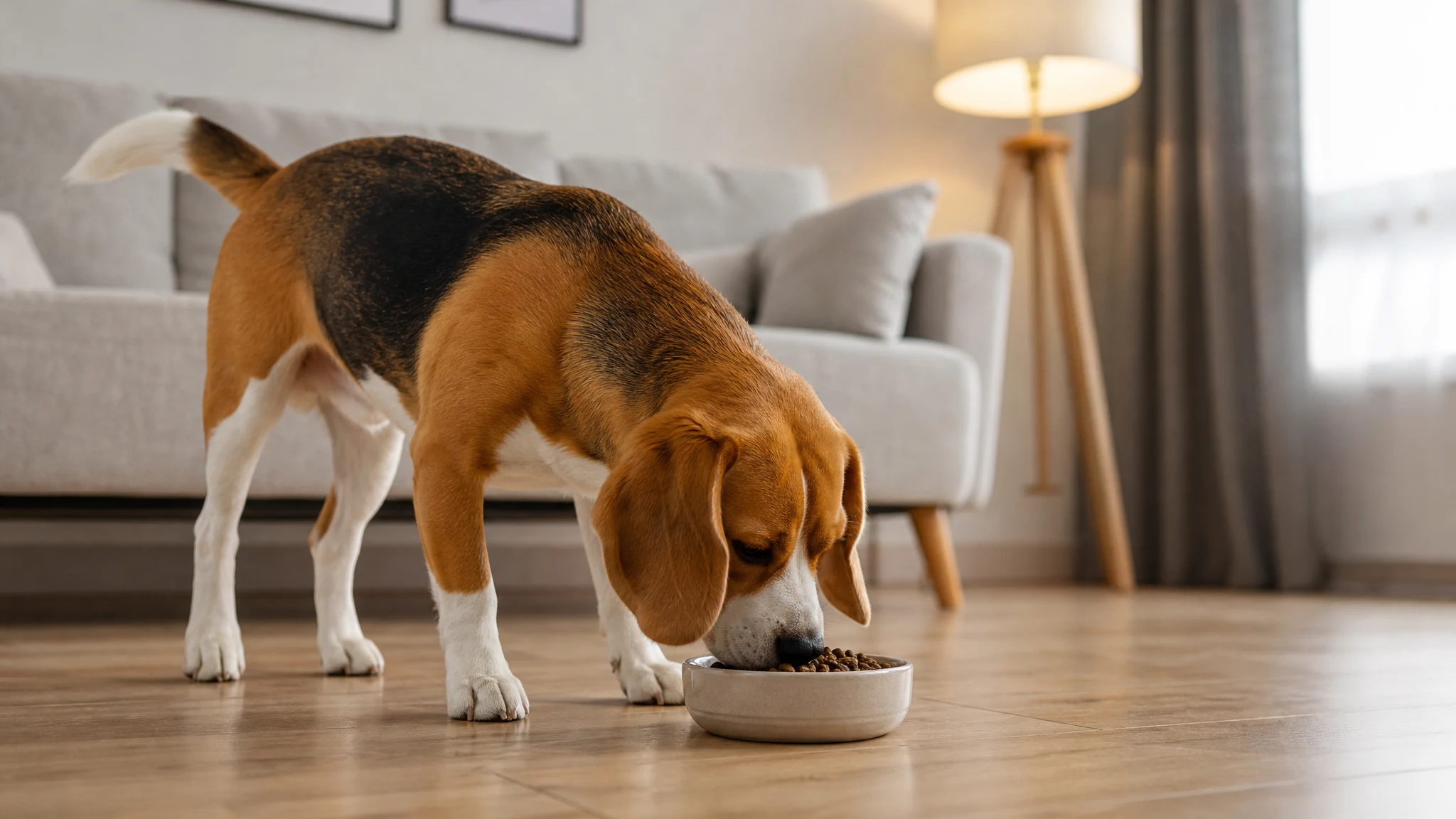
Beagles are scent hounds with a strong appetite and a well-documented tendency to gain weight. Hill's Pet Nutrition's breed page notes that Beagles can become overweight easily once they are past puppyhood, and PetMD calls obesity very common in the breed, recommending controlled portions split into two or three meals a day rather than free-feeding. Royal Canin's breed library makes the same point about weight management. Adult Beagles are generally described as 18 to 30 lb, with PetMD citing 20 to 30 lb and Royal Canin's breed page giving a top weight of 30 lb. Life expectancy is listed as 12 to 15 years by Hill's and 10 to 15 years by PetMD, so figures vary by source. No source we could open stated an official AKC size category for the Beagle, so this article avoids calling the breed "small" or "large" and sticks to the published weight range.
Because of that weight tendency, the label on a bag or can matters more than the marketing on the front of it. This guide walks through how to compare foods for a Beagle using only what the label and the brand's own product page actually say: the AAFCO statement, the life stage, the first five ingredients, the guaranteed analysis, and the calories per cup or can. We did not run a feeding trial or a taste test. This is a method for reading labels side by side, not a ranking.
What you need before comparing foods
- The dog food label itself, or the brand's own product page (not a retailer listing)
- The AAFCO nutritional adequacy statement, usually in small print near the ingredient list
- The full ingredient list, in descending order by weight
- The guaranteed analysis (minimum protein and fat, maximum fiber)
- The calorie content, usually given as kcal per cup or per can
- The feeding guide chart on the bag or page
- Your Beagle's current weight, from a recent vet visit or a home scale
- Your veterinarian's input, especially if your dog has a diagnosed condition
Step-by-step: how to compare dog foods for a Beagle
1. Find and read the AAFCO statement first
Before looking at ingredients, find the AAFCO nutritional adequacy statement. It tells you what the food is formulated for and how that was verified. Some labels say the food was "formulated to meet" AAFCO's nutrient profiles, which is a calculation. Others say feeding tests "substantiate" that the food provides complete nutrition, which means an animal feeding trial was run by the manufacturer, not by us. Hill's Science Diet products in this comparison use the feeding-test wording. Royal Canin and Freshpet products here use the formulated-to-meet wording. If a product's own page does not show this statement as text, as is the case with the Merrick recipe below, check the physical label or contact the brand directly rather than assuming it is complete and balanced.
2. Match the life stage to your Beagle's age
Royal Canin's Beagle Adult formula is labeled for purebred Beagles 12 months and older. Puppy foods are a separate category. PetMD recommends more frequent meals for puppies, up to four a day, to help prevent low blood sugar. Beagle puppies grow to a modest adult weight, well under the 70 lb threshold that defines a large-size dog under AAFCO's growth wording (as applied in state regulations such as Kentucky's 12 KAR 3:039). That matters because some growth and all-life-stages labels carry wording like "including growth of large size dogs (70 lb. or more as an adult)" or "except for growth of large size dogs." A Beagle puppy does not need that wording either way, since the breed will not reach that adult weight.
3. Read the first five ingredients
Ingredients are listed by weight before cooking, heaviest first. Compare the first five across the foods you're considering rather than reading the whole list at once. A food built mostly around named meat and meat meals reads differently than one built around rice, corn, and plant protein concentrates, even when both meet the same AAFCO statement.
4. Compare the guaranteed analysis, but check the basis
Guaranteed analysis numbers (minimum protein, minimum fat, maximum fiber) are usually given as-fed, meaning as the food sits in the bag or can, including its moisture. Hill's Science Diet publishes its numbers differently, as an "Average Nutrient & Caloric Content" on a dry-matter basis rather than as-fed guaranteed minimums. That means Hill's dry-matter averages are not directly comparable to another brand's as-fed guaranteed minimum, and we have labeled them separately in the table below rather than treating them as equivalent.
5. Compare calories per cup or per can
Because Beagles are prone to weight gain, calorie density is worth comparing directly. A food with a higher kcal-per-cup figure means a smaller daily volume for the same energy intake, which can matter for a dog that begs or free-feeds. Wet and fresh foods are measured per can or per cup of the actual product, so compare like for like.
6. Check the feeding guide against your dog's actual weight
Every feeding chart in this comparison is built around dog weight, not breed. Royal Canin's Beagle Adult chart runs by weight (26 to 40 lb) and activity level, with a calculator offered on the page. Hill's weight-control chart for Perfect Weight runs by ideal weight. Treat any chart amount as a starting point, then adjust up or down based on how your individual dog holds its weight, as Hill's own feeding notes suggest.
7. Talk to your veterinarian before switching, especially for health conditions
None of the foods compared here are described as preventing or treating a disease, and we are not making that claim either. PetMD notes Beagles can be prone to hypothyroidism, which is managed with medication and weight monitoring, not diet alone. The FDA has investigated a potential link between certain diets, including some grain-free formulas, and canine dilated cardiomyopathy (DCM); its public investigation page was last updated December 23, 2022, and states the agency does not plan further public updates until there is meaningful new scientific information. If you're considering a grain-free option like the Freshpet recipe below, or any diet change for a dog with an existing heart or thyroid issue, that conversation belongs with your veterinarian, not a label alone.
Foods compared by label data
| Brand and product | Life stage | Protein / fat (label minimum) | Calories | First five ingredients |
|---|---|---|---|---|
| Royal Canin Beagle Adult (dry) | Adult, purebred Beagles 12 months+ | 25% protein / 10% fat | 284 kcal per cup, as fed (calculated) | Corn, chicken by-product meal, brewers rice, wheat, corn gluten meal |
| Royal Canin Medium Adult (dry) | Adult maintenance | 23% protein / 12% fat | 340 kcal per cup, as fed (calculated) | Brewers rice, chicken by-product meal, oat groats, wheat, corn protein meal |
| Royal Canin Medium Puppy (dry) | Growth (puppy), 24 to 55 lb adult target weight | 30% protein / 18.4% fat | 410 kcal per cup, as fed (calculated) | Chicken by-product meal, chicken fat, brewers rice, corn, wheat |
| Hill's Science Diet Adult Perfect Weight (dry) | Adult, weight control | Not stated as a minimum; dry-matter average 28.8% protein / 11.2% fat | 298 kcal per cup | Chicken, cracked pearled barley, brown rice, pea fiber, corn protein meal |
| Hill's Science Diet Adult 7+ (dry) | Senior, maintenance | Not stated as a minimum; dry-matter average 18.7% protein / 13.5% fat | 352 kcal per cup | Chicken meal, cracked pearled barley, brewers rice, whole grain wheat, whole grain corn |
| Hill's Science Diet Puppy (dry) | Growth, and gestating or lactating adult females | Not stated as a minimum; dry-matter average 28.1% protein / 19.1% fat | 390 kcal per cup | Chicken, brown rice, whole grain wheat, chicken meal, chicken fat |
| Freshpet Roasted Meals Grain Free Chicken Recipe (fresh) | Adult maintenance | 16% protein / 10% fat | 266 kcal per cup (calculated) | Chicken, chicken liver, eggs, pea protein, pea fiber |
| Merrick Kitchen Comforts Real Chicken & Brown Rice (dry) | Not stated on the page | 26% protein / 15% fat | 420 kcal per cup | Chicken, chicken meal, brown rice, barley, oat meal |
The Merrick recipe's own page did not show its AAFCO statement as text, and its life stage was not stated either, so check the physical bag or contact Merrick directly before assuming it fits a particular stage. Hill's figures marked as dry-matter averages are not the same measurement as another brand's guaranteed minimum, and should not be read as directly comparable numbers.
Tips
- Compare one variable at a time: life stage, then ingredients, then protein and fat, then calories. Mixing all four at once makes it hard to see what's actually different between two bags.
- Write down the kcal-per-cup figure next to the feeding chart amount. For a Beagle prone to weight gain, the combination of the two tells you more than either alone.
- If a product page doesn't show the AAFCO statement, guaranteed analysis, or calorie count as text, that's a gap, not a green light. Check the physical label or ask the brand.
- Treat any feeding chart amount as a starting point. Hill's own feeding notes say to adjust amounts as necessary to maintain your dog's optimal weight.
Common mistakes to avoid
- Assuming a front-of-bag word like "natural" or "healthy" tells you anything about the guaranteed analysis. It doesn't; only the label panel does.
- Comparing Hill's dry-matter averages directly against another brand's as-fed guaranteed minimum as if they were the same kind of number.
- Free-feeding a Beagle. PetMD and Royal Canin both flag this breed's tendency toward obesity and recommend scheduled, measured meals instead.
- Assuming a growth label's "including growth of large size dogs (70 lb. or more as an adult)" wording means the food is made specifically for large breeds. It means the food is formulated to also meet those larger dogs' nutrient levels; a Beagle at 18 to 30 lb simply isn't affected by that part of the statement either way.
- Switching foods abruptly, or switching because of a health concern, without first talking to a veterinarian who knows your dog's history.
What to expect
Reading labels side by side should help you narrow a shortlist based on what's actually written on the package, rather than marketing claims. It is not a substitute for how an individual Beagle responds to a food over time, and it cannot predict weight changes, coat condition, or digestion for your specific dog. A veterinarian who knows your Beagle's weight, age, and any medical history is better positioned to confirm whether a given label is a good match.
For a longer, line-by-line version of this comparison, see our full breakdown: the best dog food for Beagles compared label by label.
Sources
- Hill's Pet Nutrition, Beagle breed page
- PetMD, Beagle breed page
- Royal Canin US, Beagle breed library
- Royal Canin, Beagle Adult product page
- Royal Canin, Medium Adult product page
- Royal Canin, Medium Puppy product page
- Hill's Science Diet, Adult Perfect Weight product page
- Hill's Science Diet, Adult 7+ product page
- Hill's Science Diet, Puppy product page
- Freshpet, Roasted Meals Grain Free Chicken Recipe product page
- Merrick, Kitchen Comforts Real Chicken & Brown Rice product page
- Kentucky 12 KAR 3:039, Nutritional adequacy
- FDA CVM, Investigation into Potential Link between Certain Diets and Canine Dilated Cardiomyopathy