Best Dry Dog Food for Beagles: Protein and Fat Compared
General nutrition information compiled from product labels and published sources, not veterinary advice. Your veterinarian is the right person to choose a diet for your dog, especially one with a health condition.
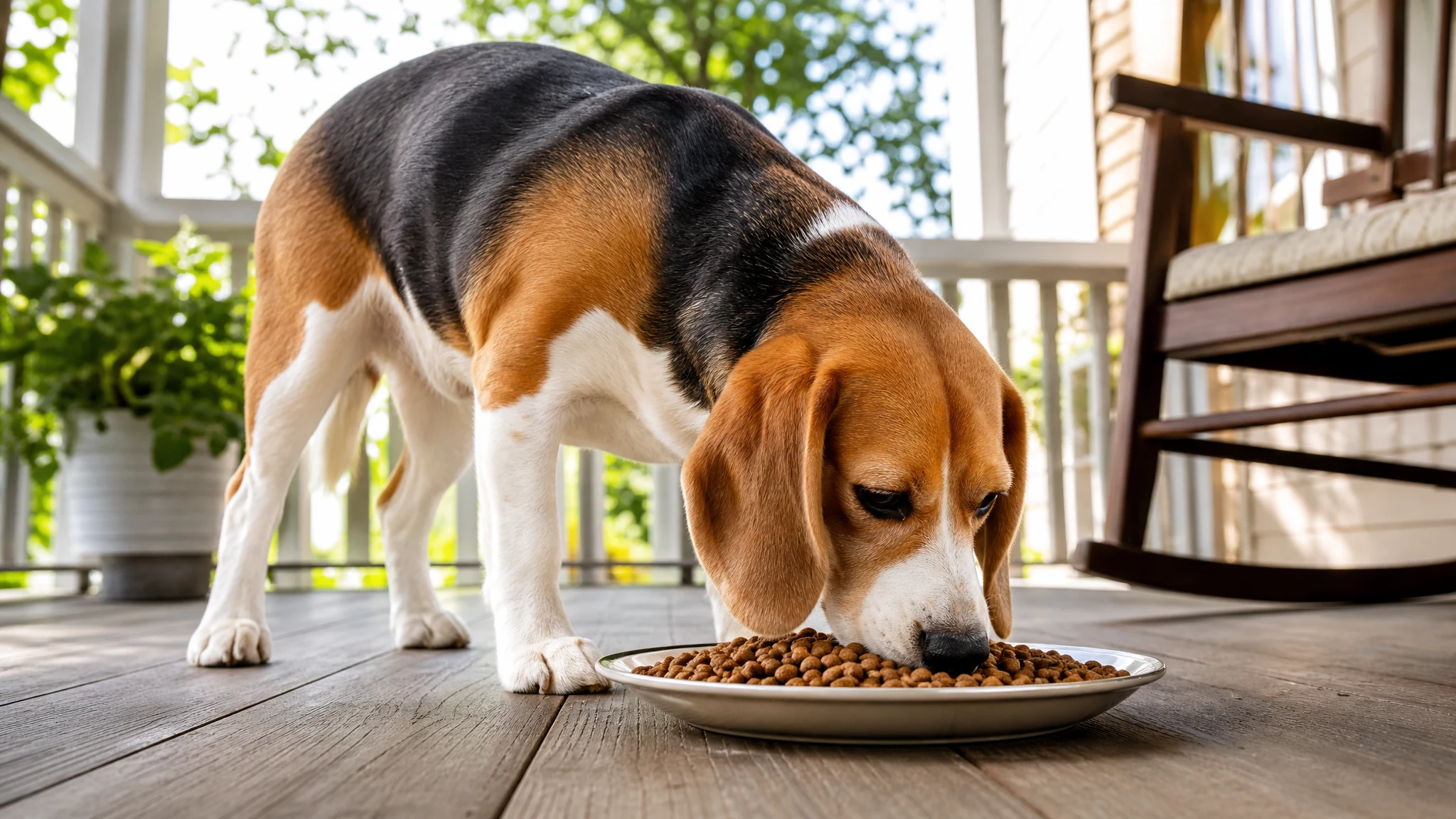
Beagles are prone to obesity, according to both Hill's Pet Nutrition's breed page and PetMD's Beagle breed page, and PetMD adds that free-feeding is not recommended for the breed. That makes the numbers on a dog food label, not the marketing on the front of the bag, the part worth slowing down for. This guide walks through how to read and compare dry dog food labels for a Beagle using only what is printed on the package: the AAFCO statement, the life stage, the guaranteed analysis, the calorie count and the ingredient list.
This is a method for comparing label data side by side. It is not a feeding trial or a taste test, and nothing here is a claim that any food prevents, treats or cures a health condition. A veterinarian is the one who can weigh in on what is right for an individual dog, especially if that dog has a diagnosed condition such as hypothyroidism, which PetMD lists as common in Beagles and managed through medication and weight monitoring, not through a specific food.
What You Need Before You Compare
- The bag or the brand's own product page for each food you want to compare
- The AAFCO nutritional adequacy statement, usually in small print near the ingredient list
- The guaranteed analysis panel, which lists minimum crude protein and minimum crude fat
- The calorie statement, given as kcal per cup or per kilogram
- The first five ingredients, listed by weight
- Your Beagle's current weight, ideally from a scale or a recent vet visit, since Hill's Pet Nutrition and PetMD both note the breed's weight range runs from about 18 to 30 pounds
Step by Step: How to Compare Dry Food Labels for a Beagle
- Find the AAFCO statement and the life stage first. Every complete and balanced dog food carries a statement saying it is formulated to meet, or has been tested to meet, AAFCO's nutrient profiles for a specific life stage: growth, adult maintenance, or all life stages. Royal Canin's Beagle Adult formula, for example, states on its product page that it is formulated to meet AAFCO's profiles for maintenance, and is intended for purebred Beagles 12 months and older. If a label does not list an AAFCO statement at all, as is the case with the text available on Merrick's Kitchen Comforts Real Chicken & Brown Rice page, check the brand's own site or packaging directly rather than guessing at the life stage.
- Check whether a growth formula mentions large-breed wording, and know it does not apply to a Beagle. State rules that adopt AAFCO's standard label language, such as Kentucky's regulation 12 KAR 3:039 on nutritional adequacy, require a growth or all-life-stages food to state whether it is formulated for "growth including growth of large size dogs (70 lb. or more as an adult)" or formulated "except for" that group. Royal Canin's Medium Puppy dry food carries the "including" wording. A Beagle, at roughly 18 to 30 pounds as an adult per Hill's Pet Nutrition, is well under that 70-pound line, so the large-breed growth calcium rules behind that label language are not something a Beagle owner needs to weigh.
- Compare minimum crude protein and minimum crude fat, side by side. These are listed as percentage minimums on the guaranteed analysis panel. Royal Canin's Beagle Adult dry food lists 25.0 percent minimum protein and 10.0 percent minimum fat. Royal Canin's Medium Adult dry food lists 23.0 percent protein and 12.0 percent fat. One important caveat: Hill's Science Diet publishes its protein and fat figures as dry-matter average nutrient content on a separate table, not as as-fed guaranteed minimums on the analysis panel, so those two sets of numbers are not directly comparable to Royal Canin's or Merrick's as-fed minimums. Treat the Hill's dry-matter figures as their own category.
- Line up the calorie count per cup. Calorie density varies more between foods than most shoppers expect, and it matters more for a breed where Hill's Pet Nutrition and PetMD both flag a tendency to gain weight. Royal Canin's Beagle Adult formula calculates to about 284 kcal per cup, while Royal Canin's Medium Puppy dry food runs closer to 410 kcal per cup, reflecting the higher energy needs of a growing puppy versus an adult.
- Read the first five ingredients, listed by weight. This tells you what makes up the bulk of the food, though it does not by itself tell you overall nutrient quality. Royal Canin's Beagle Adult formula lists corn first, followed by chicken by-product meal, brewers rice, wheat and corn gluten meal. Merrick's Kitchen Comforts recipe lists chicken first, followed by chicken meal, brown rice, barley and oat meal.
- Match the feeding guide to your Beagle's actual weight, not a guess. Royal Canin's feeding tables are built around dog weight and activity level; its Beagle Adult guide covers dogs from 26 to 40 pounds at low, medium or high activity. Hill's feeding charts work the same way, built around the dog's current or ideal weight. Use the figure on the chart as a starting point, then adjust based on how your dog's body condition changes, as several of these labels themselves advise.
- Introduce any new food gradually. None of the brands reviewed here publish a specific transition schedule in the text available on their pages, so if you switch foods, watch your dog and ask your veterinarian if you are unsure how quickly to move from one food to another.
Dry Dog Foods Compared by Label Data
These are label figures only. Nothing below reflects a taste test or a feeding trial run by this site, and the calorie and percentage figures come from each brand's own product page.
| Brand and Product | Life Stage | Protein / Fat | Calories | First Ingredients |
|---|---|---|---|---|
| Royal Canin Beagle Adult | Adult, purebred Beagles 12 months and older | 25.0% / 10.0% (as fed minimums) | ~284 kcal/cup | Corn, chicken by-product meal, brewers rice, wheat, corn gluten meal |
| Royal Canin Medium Adult | Adult maintenance | 23.0% / 12.0% (as fed minimums) | ~340 kcal/cup | Brewers rice, chicken by-product meal, oat groats, wheat, corn protein meal |
| Royal Canin Medium Puppy | Growth, including large-breed growth wording | 30.0% / 18.4% (as fed minimums) | ~410 kcal/cup | Chicken by-product meal, chicken fat, brewers rice, corn, wheat |
| Hill's Science Diet Adult Perfect Weight | Adult maintenance, weight control | 28.8% / 11.2% (dry-matter average, not a label minimum) | 298 kcal/cup | Chicken, cracked pearled barley, brown rice, pea fiber, corn protein meal |
| Hill's Science Diet Adult 7+ | Senior maintenance | 18.7% / 13.5% (dry-matter average, not a label minimum) | 352 kcal/cup | Chicken meal, cracked pearled barley, brewers rice, whole grain wheat, whole grain corn |
| Hill's Science Diet Puppy | Growth, and gestating or lactating females | 28.1% / 19.1% (dry-matter average, not a label minimum) | 390 kcal/cup | Chicken, brown rice, whole grain wheat, chicken meal, chicken fat |
| Merrick Kitchen Comforts Chicken & Brown Rice | Not stated in the text available on Merrick's page; check with Merrick | 26.0% / 15.0% (as fed minimums) | 420 kcal/cup | Chicken, chicken meal, brown rice, barley, oat meal |
For a longer, line-by-line walk through these same labels, see this label-by-label comparison of dog food for Beagles.
Tips
- Compare protein and fat within the same type of figure. Mixing Hill's dry-matter averages with another brand's as-fed minimums will make foods look more different, or more similar, than they really are.
- Use the calorie count, not just the bag size, to judge how much a cup actually costs you in energy. A smaller serving of a calorie-dense food can deliver the same energy as a larger serving of a lighter one.
- If a Beagle has a diagnosed condition such as hypothyroidism, which PetMD notes is common in the breed, loop in a veterinarian before switching foods rather than choosing based on label comparisons alone.
Common Mistakes to Avoid
- Do not assume a growth formula's large-breed wording applies to a Beagle. At 18 to 30 pounds, per Hill's Pet Nutrition, the breed falls well under the 70-pound threshold referenced in that label language.
- Do not free-feed. PetMD specifically advises against free-feeding for this breed given its tendency toward weight gain.
- Do not treat a food as a treatment for a medical condition. A food's AAFCO statement and ingredient list describe nutrition, not a therapy, and prescription diets are only ever something a veterinarian prescribes for an individual dog.
- Do not rely on front-of-bag claims in place of the AAFCO statement and guaranteed analysis. If a brand's page does not show these as text, as is the case with Merrick's AAFCO statement, check directly with the brand before assuming a life stage or nutrient level.
What to Expect
Comparing labels this way may help narrow a shortlist of foods that match your Beagle's life stage and activity level, but it cannot predict how an individual dog will do on a given food, and it is not a substitute for monitoring body weight over time. The FDA's investigation into a potential link between certain diets and canine dilated cardiomyopathy notes that as of its last public update, the agency did not have new findings requiring further public guidance. If you have concerns about a specific ingredient or formula, raise them with your veterinarian rather than drawing conclusions from label comparisons alone.
Sources
- Hill's Pet Nutrition, Beagle breed page
- PetMD, Beagle breed page
- Royal Canin US, Beagle breed library
- Royal Canin, Beagle Adult product page
- Royal Canin, Medium Adult product page
- Royal Canin, Medium Puppy product page
- Hill's Science Diet, Adult Perfect Weight product page
- Hill's Science Diet, Adult 7+ product page
- Hill's Science Diet, Puppy product page
- Merrick, Kitchen Comforts Chicken & Brown Rice product page
- Kentucky 12 KAR 3:039, Nutritional adequacy
- FDA CVM, Investigation into Potential Link between Certain Diets and Canine Dilated Cardiomyopathy