Best Puppy Food for Beagle Puppies
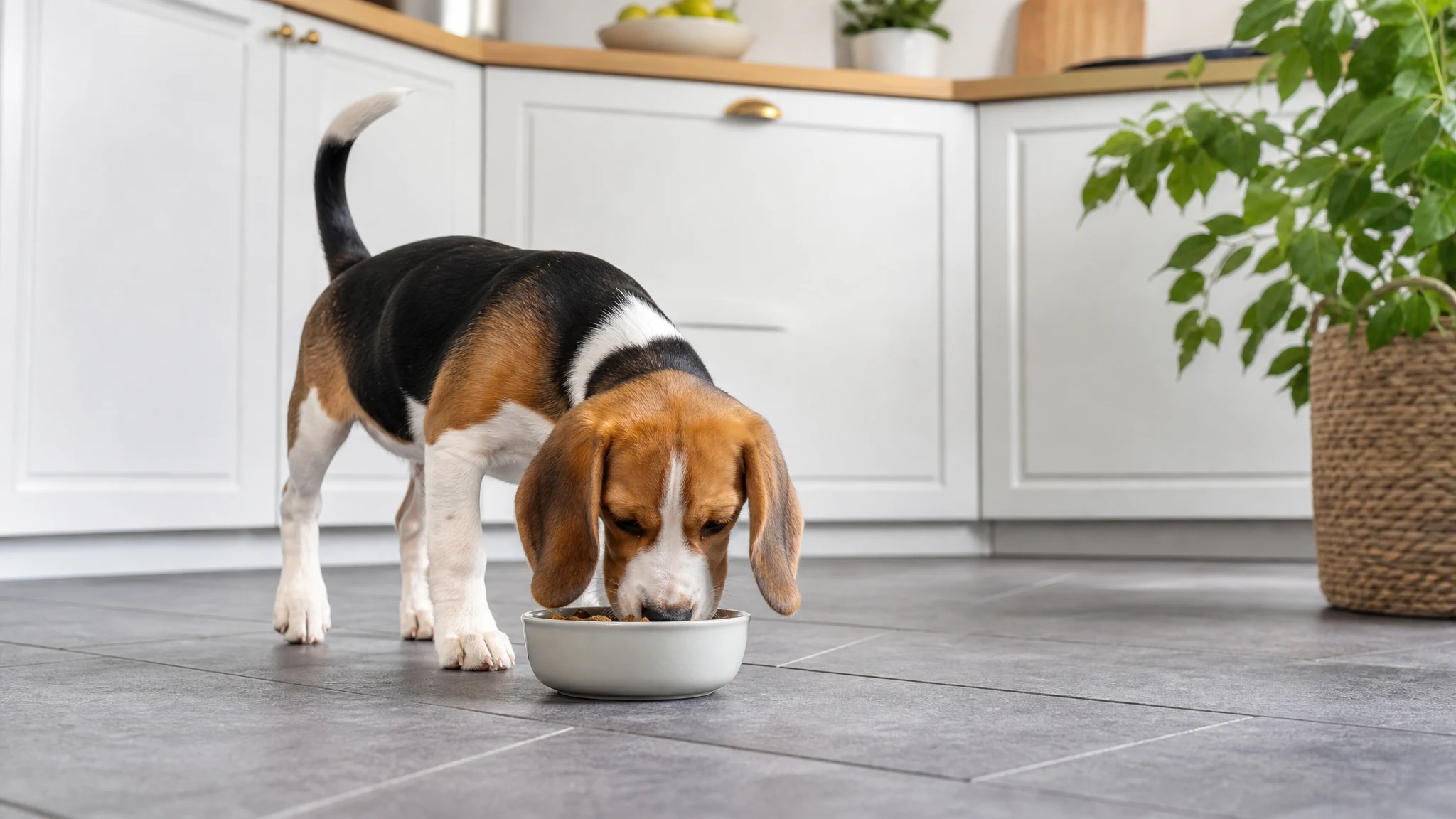
General nutrition information compiled from product labels and published sources, not veterinary advice. Your veterinarian is the right person to choose a diet for your dog, especially one with a health condition.
Choosing the best puppy food for Beagles is mostly an exercise in reading labels. Marketing on the front of the bag says little. The small print on the back says a lot more.
This guide covers what to look for in Beagle puppy food, which features are worth comparing, three growth-labeled foods to start from, red flags, and where to buy. We compared label data published by the brands. We did not run feeding trials or taste tests, and we have not fed any of these foods to a dog.
First, what kind of puppy is a Beagle?
Hill's Pet Nutrition lists the adult Beagle at 18 to 30 lb. PetMD gives 20 to 30 lb. No source we relied on assigns the breed an official size category, so this guide sticks to those weights.
That matters for one label detail. AAFCO wording, as applied in state rules such as Kentucky 12 KAR 3:039, requires a growth or all-life-stages dog food to say one of two things. It either says it is formulated for growth "including growth of large size dogs (70 lb. or more as an adult)" or "except for growth of large size dogs (70 lb. or more as an adult)." A Beagle is far below that 70 lb line.
So for a Beagle puppy, a food with either phrase can be a reasonable candidate. The "including" phrase means the food is formulated to the large-breed growth levels as well. It is not a sign the food is wrong for a small or medium dog. What you want is a growth statement of some kind, not a maintenance-only one.
What to look for on a Beagle puppy food label
1. A growth statement from AAFCO
Find the nutritional adequacy statement, usually in small print near the ingredients. For a puppy it should say the food meets the AAFCO Dog Food Nutrient Profiles for growth, or that animal feeding tests substantiate it for growing puppies. An "adult maintenance" statement is written for adult dogs, not for a growing puppy.
If you cannot find the statement on a brand's page, treat that as a gap and ask the brand directly.
2. A life stage that matches your puppy
Check the stated life stage, not just the word "puppy" in the product name. Some foods are labeled for all life stages, and some puppy foods are made for specific adult sizes. Read the feeding table to see whether your puppy's expected adult weight appears in it.
3. Calories per cup
Hill's says some Beagles gain weight easily after puppyhood. PetMD says obesity is very common in the breed and recommends controlled portions rather than free-feeding. Royal Canin's breed library also says Beagles are prone to obesity.
Calories per cup, or per can for wet food, tell you how much energy a portion carries. Puppy foods are usually richer than adult foods, so measure rather than guess.
4. The first few ingredients
Ingredient lists are in order by weight before cooking. Look at the first five and see whether you can tell what they are. "Chicken" and "chicken by-product meal" are different ingredients, and neither is automatically better or worse. The list tells you what the food is made from. It does not tell you how well the food performs.
5. Protein, fat and fiber on the same basis
Percentages only compare fairly when they are on the same basis. Most brands publish as-fed guaranteed analysis minimums and maximums. Hill's publishes dry-matter averages instead. A dry-matter number looks larger than an as-fed number for the same food, so never set one beside the other.
Key features to compare
- Form: dry, wet or fresh. Each has a different calorie density and feeding routine.
- Calories: per cup for dry food, per can for wet food.
- Feeding guide range: does the table cover a dog of Beagle size?
- AAFCO wording: growth, with or without the large-breed phrase.
- Grain content: the foods below all contain grains. Grain-free is a style choice, not a quality marker. The FDA's investigation into a possible link between certain diets and canine dilated cardiomyopathy (DCM) was last updated on December 23, 2022, and the agency said it did not plan further public updates until there is meaningful new scientific information. Your veterinarian is the person to ask about this for an individual dog.
Three growth-labeled foods to start your comparison
We list no prices, ratings or reviews on purpose. Prices change by store and size, and we have no way to verify them. Instead of price tiers, the picks below are grouped by form and by how each brand backs its growth claim.
Only foods whose published statement covers growth are included. There is no Beagle puppy formula from these brands in the information we reviewed. Royal Canin makes a Beagle Adult formula for purebred Beagles 12 months and older, but that is an adult food.
Royal Canin Medium Puppy Dry
Royal Canin's page states the food is formulated to meet the AAFCO Dog Food Nutrient Profiles for growth, including growth of large size dogs (70 lb. or more as an adult).
- First five ingredients: chicken by-product meal, chicken fat, brewers rice, corn, wheat.
- Guaranteed analysis: protein at least 30.0 percent, fat at least 18.4 percent, fiber at most 4.0 percent.
- Calories: 410 kcal ME per cup, as fed (calculated).
- Grain-free: no.
- Feeding table: by puppy age (2 to 13 months) and adult target weight (24 to 55 lb).
Note the table's lower end. If you expect your Beagle to finish at 18 to 23 lb, the table does not list that weight. Treat the nearest row as a rough starting point and check with your veterinarian.
The kibble size is not stated on the page. Royal Canin describes a crunchy kibble texture. The brand page is at royalcanin.com.
Royal Canin Medium Puppy Thin Slices in Gravy (wet)
This wet food carries the same growth statement, including the large-size wording. It can be used on its own or compared as a topper, depending on what the brand says.
- First five ingredients: water sufficient for processing, chicken, pork by-products, chicken liver, brewers rice flour.
- Guaranteed analysis: protein at least 6.8 percent, fat at least 4.5 percent, fiber at most 1.6 percent.
- Calories: 356 kcal ME per can, as fed (calculated). The can size was not stated in the text we reviewed.
- Feeding amount: the page gives no fixed amount. It offers a calculator for a tailored recommendation.
Wet food is mostly water, so its percentages look low next to dry food. That is not a flaw. It is a different basis. Since the can size is unclear, check it with the brand before working out portions. The product page is at royalcanin.com.
Hill's Science Diet Puppy Chicken & Brown Rice Recipe (dry)
Hill's uses a different kind of statement. It says animal feeding tests using AAFCO procedures substantiate that the food provides complete and balanced nutrition for growing puppies and for gestating or lactating adult female dogs.
- First five ingredients: chicken, brown rice, whole grain wheat, chicken meal, chicken fat.
- Dry-matter averages (not label minimums): protein 28.1 percent, fat 19.1 percent, crude fiber 2.7 percent.
- Calories: 390 kcal per cup (3721 kcal/kg).
- Grain-free: no.
- Feeding guidance: Hill's says to adjust amounts as necessary to maintain optimal weight, and to ask your veterinarian if you are unsure.
The page we reviewed did not show the large-size "including" or "except for" wording, and it did not list a kibble size. A Beagle falls well below that line, but ask Hill's if the wording matters to you. A smaller-kibble version exists, so check the brand page for the version you plan to buy. The product page is at hillspet.com.
Quick comparison
| Food | Form | Growth statement | Calories |
|---|---|---|---|
| Royal Canin Medium Puppy Dry | Dry | Growth, including large size dogs | 410 kcal ME per cup |
| Royal Canin Medium Puppy Thin Slices in Gravy | Wet | Growth, including large size dogs | 356 kcal ME per can (size not stated) |
| Hill's Science Diet Puppy Chicken & Brown Rice | Dry | Feeding tests for growth | 390 kcal per cup |
All three are labeled for growth. They differ in form, calorie density and how the brand supports its claim. None of them is a treatment for any condition, and none is proven to suit every Beagle.
How to feed a Beagle puppy
Meals per day
PetMD advises more frequent meals for Beagle puppies, up to four a day, to help prevent low blood sugar. Once your puppy is older, PetMD recommends two to three meals a day of a well-balanced commercial food, with no free-feeding.
Treat label amounts as a starting point
Feeding tables are guides. Royal Canin notes its table is only a guide and that grams are the most accurate way to measure. Merrick says its numbers are an initial recommendation to adjust. Hill's says to adjust amounts to maintain optimal weight. Weigh your puppy regularly and ask your veterinarian whether the portion needs to change.
Count the treats
Training treats and chews add calories too. If the breed gains weight easily, small extras add up. Take a little out of the meal portion on days with heavy treat use.
When to switch to adult food
Royal Canin's Beagle Adult formula is made for purebred Beagles 12 months and older. That is one brand's age line, not a rule for every dog. Some Beagles may be ready earlier or later.
Your veterinarian can tell you when your puppy is ready. When the time comes, compare the adult food's calories per cup with the puppy food's. Puppy foods are often richer, so a cup-for-cup swap can give more or fewer calories than you expect. Making the change gradually is the usual advice.
Red flags to avoid
- No adequacy statement. If you cannot find an AAFCO statement for growth, do not guess. Ask the brand. We found none as text on the Merrick page we reviewed, so we left it out of this guide.
- A maintenance-only statement on a puppy. That food is written for adult dogs.
- Claims that a food prevents or cures a disease. No food label should promise that for hip dysplasia, allergies, DCM or bloat. PetMD notes that Beagles may be prone to IVDD, hip dysplasia and patellar luxation, and the diet-relevant factor it names is body weight, not a special recipe. A veterinarian decides what is right for an individual dog.
- Prescription-style language from a non-prescription brand. Prescription diets are something only a veterinarian prescribes.
- Vague "premium" or "natural" wording. Look for the facts: the statement, the analysis and the calories.
- Free-feeding advice. It runs against the guidance from PetMD for this breed.
- Claims from one source only. A brand page tells you what the brand says. Compare it with the label on the bag in your hands.
Where to buy
We do not link to stores or recommend a seller. Several routes are worth knowing:
- The brand's own website. Brand pages show the ingredient list, guaranteed analysis and feeding table for the exact product. Check the brand's own page to see where it sells.
- A local pet supply store. You can read the bag label in person and ask staff to check the stage and size line.
- Your veterinarian's office. Many clinics can talk through a puppy's food, and some stock puppy diets.
Whichever you choose, check that the product name, life stage and adequacy statement on the bag match what you read online. Formulas can change, and so can packaging.
The bottom line
The best food for a Beagle puppy is one with a growth statement, a clear ingredient list, a feeding guide that fits the dog and a calorie level you can measure. Because the breed gains weight easily, portions matter as much as the brand. Start with a label you understand, feed several measured meals a day while your puppy is young, and keep your veterinarian in the loop.
Sources
- Hill's Pet Nutrition, Beagle breed page
- PetMD, Beagle breed page
- Royal Canin US, Beagle breed library
- Royal Canin US, Beagle Adult product page
- Royal Canin US, Medium Puppy product page
- Royal Canin US, Medium Puppy Thin Slices in Gravy product page
- Hill's Science Diet, Puppy Chicken & Brown Rice product page
- Kentucky 12 KAR 3:039, Nutritional adequacy
- FDA CVM, Investigation into Potential Link between Certain Diets and Canine Dilated Cardiomyopathy