Wet vs Dry vs Fresh Food for Beagles
General nutrition information compiled from product labels and published sources, not veterinary advice. Your veterinarian is the right person to choose a diet for your dog, especially one with a health condition.
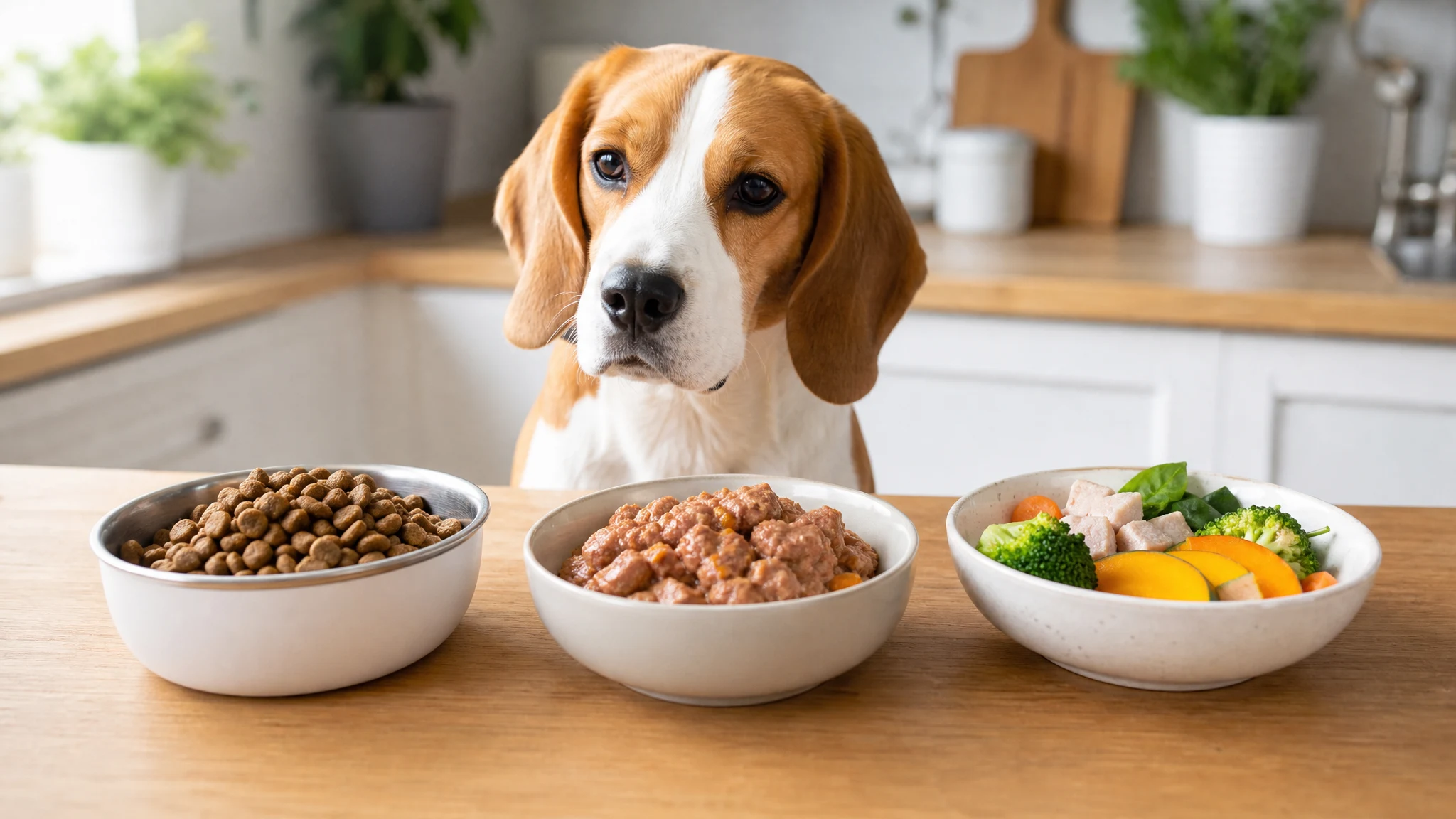
Wet vs dry dog food is one of the first choices a Beagle owner faces, and fresh food adds a third option. Each form can be complete and balanced. The differences are in water content, calories per scoop or can, how easy portions are to control, and how much each costs to feed over a month.
For a Beagle, portion control matters more than most. Hill's Pet Nutrition says some Beagles easily become overweight after puppyhood. PetMD calls obesity very common in the breed and advises controlled meals rather than free-feeding. So the question is less "which form is best?" and more "which form helps me feed the right amount, every day?"
How this comparison was made
We compared label data published by the brands: AAFCO statements, ingredient lists, guaranteed analysis and calories. We did not run feeding trials or taste tests, and we did not feed any of these foods to dogs. The products named below are examples of each form, not a ranking. For the full product-by-product look, see our label-by-label comparison of dog foods for Beagles.
The Beagle facts that shape the choice
Hill's lists the adult Beagle at 18 to 30 lb, PetMD says 20 to 30 lb, and Royal Canin's breed page gives a top weight of 30 lb. That is a modest daily calorie budget, and a few extra bites add up fast.
PetMD recommends two to three meals a day for adults, with puppies eating more often, up to four meals a day to help prevent low blood sugar. Beagles are not large-breed puppies, so the large-breed growth calcium rules do not apply to them. Royal Canin's Beagle Adult formula is written for purebred Beagles 12 months and older.
PetMD also notes that Beagles may be susceptible to intervertebral disc disease, hip dysplasia and patellar luxation, and that hypothyroidism is common. The source ties body weight to these concerns, not any one food form. No food form treats or prevents them, and a veterinarian decides what suits an individual dog.
Side-by-side table
| Attribute | Dry | Wet | Fresh |
|---|---|---|---|
| Example label | Royal Canin Beagle Adult | Hill's Science Diet Adult 7+ Senior Vitality Chicken & Vegetable Stew | Freshpet Roasted Meals Grain Free Chicken Recipe with Garden Vegetables |
| First ingredients | Corn, chicken by-product meal, brewers rice, wheat, corn gluten meal | Chicken broth, chicken, pork liver, rice, carrots | Chicken, chicken liver, eggs, pea protein, pea fiber |
| Calories as published | 284 kcal ME per cup | 286 kcal per 12.5 oz can | 266 kcal per cup |
| Label protein, as fed | 25.0% minimum | Hill's gives only a dry-matter average (22.2%) | 16% minimum |
| Portion guide on the page | Table by weight (26 to 40 lb) and activity level | Cans per day by weight; a 20 lb dog gets 1 3/4 cans | Cups per day by weight, one meal or split into two |
| Cost per day | Generally the lowest of the three | Generally higher than dry | Generally the highest |
The cost row is a general pattern, not a price. We list no prices because they vary by store, bag or case size and region. Check the brand for current options.
Moisture and what it does to the label
Wet food is mostly water. That shows in the ingredient lists: Royal Canin's Medium Puppy thin slices in gravy opens with "water sufficient for processing," and Hill's stew opens with chicken broth. The numbers follow. The Royal Canin wet puppy recipe lists a protein minimum of 6.8%, while its dry puppy counterpart lists 30%.
That does not mean the wet recipe has less protein in any meaningful sense. It means the water is diluting the percentage. To compare forms fairly, you need dry-matter figures or calories, not raw as-fed percentages.
One caution on Hill's. Its pages publish dry-matter averages rather than as-fed guaranteed minimums. Those averages are not directly comparable to the minimums on another brand's page, so do not put them side by side without adjusting.
Calories per serving
This is where Beagle owners should look hardest. A cup of dry food and a can of wet food are not the same size, and different dry foods vary a lot. Published figures include:
- Royal Canin Beagle Adult dry: 284 kcal ME per cup, as fed (calculated).
- Hill's Science Diet Adult Perfect Weight dry: 298 kcal per cup.
- Royal Canin Medium Adult dry: 340 kcal ME per cup.
- Merrick Kitchen Comforts Real Chicken & Brown Rice dry: 420 kcal per cup.
- Freshpet Roasted Meals Grain Free Chicken fresh: 266 kcal per cup.
- Hill's Adult 7+ Senior Vitality stew wet: 286 kcal per 12.5 oz can.
The spread among dry foods alone is large. Scooping the same cup of the 420 kcal food instead of the 284 kcal food delivers roughly 48% more energy. Fresh food looks lighter per cup, but a cup of a soft, moist food is not the same volume of nutrition as a cup of kibble, so go by the brand's own chart.
The Hill's stew chart shows how wet portions scale. It lists 1 3/4 cans a day for a 20 lb dog, which works out to about 500 kcal from that label's own figure. That is a lot of cans for a dog with a small daily budget, which is one reason wet food is often used as a topper or part of a meal rather than the whole diet. Royal Canin's wet puppy page gives 356 kcal per can but does not state the can size in the text we reviewed, so check the brand before comparing it with anything.
Every feeding guide in the sources is a starting point. Brands say so themselves. Merrick calls its table an initial recommendation to adjust as needed, and Hill's says to adjust amounts to maintain optimal weight.
Dry food: pros and cons
Pros
- Usually the most economical per day, in general terms.
- Easy to measure, store and divide into two or three meals.
- Wide choice of life-stage and weight-control labels, including Hill's Adult Perfect Weight and breed-specific options.
- Royal Canin makes a Beagle formula with a custom kibble shaped for the breed's square muzzle to encourage slower eating. The brand does not state the kibble size.
Cons
- Calorie density varies a lot, so a "cup" means very different things between brands.
- A scoop is a loose measure. Weighing in grams is more accurate, as Royal Canin notes on its Medium Adult page.
- Some Beagles gulp. A slow-eating kibble shape is one option, though no source we reviewed shows how well it works in practice.
Wet food: pros and cons
Pros
- High water content, so each can looks like a bigger serving for its calories.
- Strong aroma and soft texture. Owners often use wet food for Beagles that are picky or recovering from illness, though your veterinarian should guide that.
- No kibble size to worry about.
Cons
- Generally costs more per day than dry.
- Cans are bulky to store, and opened food needs refrigeration and prompt use.
- Label percentages look low because of the water, which can confuse comparisons.
If you are weighing wet food for Beagles specifically, the breed's weight tendency is the main reason to be careful. A full can-based diet can work, but you would be counting cans against a small calorie budget every day.
Fresh food: pros and cons
Pros
- The ingredient list reads like a short list of recognizable foods: chicken, chicken liver, eggs and so on.
- Freshpet's example states an AAFCO adult maintenance statement and gives cup amounts by dog weight, one meal or split into two.
- At 266 kcal per cup, it is the lowest of the examples above on a per-cup basis.
Cons
- Typically the highest cost per day of the three forms.
- Needs cold storage, which affects travel and planning.
- The example we reviewed is grain-free. The FDA's investigation into a possible link between certain diets and canine dilated cardiomyopathy (DCM) was last updated December 23, 2022, and the agency said it did not plan further public updates until there was meaningful new science. The FDA page is where to read what it says. If you are considering a grain-free food, ask your veterinarian.
- Fresh dog food for Beagles is less standardized than dry. Not every fresh brand publishes its calories, analysis and feeding table in the same way, so confirm details on the brand's own page.
The dental myth
A common claim is that dry food cleans teeth and wet food ruins them. None of the sources we relied on for this comparison supports that either way. Hill's, PetMD and Royal Canin do not tie a food form to dental health for Beagles in the pages we reviewed.
Do not choose a form on the assumption that kibble does the work of a toothbrush. Dental care is a question for your veterinarian, who can look at an individual dog's mouth.
Mixing forms
Many owners combine forms, such as a scoop of dry food with a spoonful of wet food on top. It can work, with one rule: count everything. Each added spoonful has calories, so the dry portion should shrink to match.
A practical approach is to take the daily amount from the brand's feeding guide, then decide how much of the calorie budget each food will cover. Using the same brand and a similar life stage keeps the label math simple. If you mix brands, add the figures yourself and watch your Beagle's weight, then adjust. Your veterinarian can help set a target.
Best for: use cases
- Tight budget and easy portions: dry. Measure by weight and split into two or three meals, as PetMD suggests.
- A fast eater: dry in a Beagle-shaped kibble, or any food served in measured meals. Royal Canin's Beagle formula is built around slower eating, but check the brand for what it claims.
- A dog that needs weight control: a weight-control dry label such as Hill's Adult Perfect Weight, with the weight-loss and weight-management columns in its feeding table, but only with a veterinarian's guidance on the target.
- A picky eater or a topper for kibble: wet, in small, counted amounts.
- An owner who wants minimally processed-looking ingredients and can pay more: fresh, with the DCM question raised with your veterinarian if the recipe is grain-free.
- A growing puppy: any form that states a growth or all-life-stages AAFCO statement. Royal Canin's puppy labels say "including growth of large size dogs (70 lb. or more as an adult)." A Beagle is far below that line. The label wording still tells you the food meets the large-breed growth levels, which is more than a Beagle puppy needs.
- A senior Beagle: Hill's Adult 7+ comes in both dry and wet. Ask your veterinarian before switching.
Verdict
For most Beagles, a measured, complete-and-balanced dry food is the most practical starting point. It is the easiest form to portion, the cheapest to keep up, and the easiest to compare by calories per cup. For a breed prone to weight gain, predictability counts for a lot.
Wet food earns its place as a topper or a small part of a meal, as long as it is counted. It is a poor fit as an unmeasured extra. Fresh food is a reasonable option if you value the ingredient list and can accept the cost and cold storage. Check the calories, and talk to your veterinarian about grain-free recipes.
Whatever the form, three things matter more than the form itself: an AAFCO statement for the right life stage, a calorie figure you can actually measure, and a body weight you check regularly. If your Beagle gains or loses weight on the label amount, adjust and ask your veterinarian.
Sources
- Hill's Pet Nutrition, Beagle breed page
- PetMD, Beagle breed page
- Royal Canin US, Beagle breed library
- Royal Canin US, Beagle Adult
- Royal Canin US, Medium Adult
- Royal Canin US, Medium Puppy thin slices in gravy
- Hill's Science Diet, Adult Perfect Weight
- Hill's Science Diet, Adult 7+ Senior Vitality Stew
- Freshpet, Roasted Meals Grain Free Chicken Recipe
- Merrick, Kitchen Comforts Real Chicken & Brown Rice
- FDA CVM, investigation into diets and canine dilated cardiomyopathy