How Much to Feed a Beagle: Feeding Chart by Age and Weight
General nutrition information compiled from product labels and published sources, not veterinary advice. Your veterinarian is the right person to choose a diet for your dog, especially one with a health condition.
Working out how much to feed a Beagle is mostly a matter of reading the label, weighing the dog and watching the waistline. This guide walks through each step in order.
The answer to "how much should a Beagle eat" is not one number. It depends on the food, the dog's age, weight and activity, and how the dog looks and feels. Every feeding chart on a bag or can is a starting point. A veterinarian sets the amount for an individual dog.
Why Beagle portions need extra care
Hill's Pet Nutrition says some Beagles easily become overweight after puppyhood, so calories need watching. PetMD calls obesity very common in the breed and advises controlled amounts of a well-balanced commercial food, two to three meals a day, with no free-feeding. The Royal Canin breed library also says Beagles are prone to obesity.
Hill's lists the adult Beagle at 18 to 30 lb, and PetMD gives 20 to 30 lb. Royal Canin's breed page gives a top weight of 30 lb. None of the sources we read gives an official size category, so this article uses the published weight range instead of calling the breed small or large.
PetMD also notes that Beagles may be susceptible to intervertebral disc disease, hip dysplasia and patellar luxation. It does not link these to diet. Body weight is the diet-related factor it points to. No food prevents or treats these conditions, and your veterinarian decides what is right for your dog.
What you need before you start
- The food's bag, can or package, with the feeding guide and calorie statement.
- A kitchen scale that measures in grams, or a standard dry measuring cup.
- A bathroom scale or a veterinary clinic scale to weigh your dog.
- A notebook or phone note for weights, portions and treats.
- Your veterinarian's contact details for questions about your dog.
How we built the chart
We compared label data published by the brands. We did not run feeding trials or taste tests, and we did not feed any of these foods to dogs. The figures below are what each brand publishes, so check the current label on the product you buy.
Step 1: Weigh your Beagle and note the life stage
Start with a current weight. A Beagle that is still growing, a healthy adult and a senior dog all have different needs.
Royal Canin says its Beagle Adult formula is for purebred Beagles 12 months and older. PetMD advises more frequent puppy meals, up to four a day, to help prevent low blood sugar. For adults, PetMD recommends two to three meals a day.
| Life stage | Meals per day (PetMD) | Notes |
|---|---|---|
| Puppy | Up to four | Choose a growth or all life stages food. Check the label wording described in Step 2. |
| Adult (about 12 months and older) | Two to three | Adult weight is published at 18 to 30 lb. Avoid free-feeding. |
| Senior | Ask your veterinarian | Some foods are labeled adult 7+. Weight monitoring still matters. |
Step 2: Pick a complete and balanced food and read the statement
Look for the AAFCO nutritional adequacy statement. It tells you which life stage the food is formulated for.
For puppy foods, look for the large-size wording. State pet-food rules that adopt AAFCO labeling, such as Kentucky regulation 12 KAR 3:039, require a growth or all life stages food to say either "including growth of large size dogs (70 lb. or more as an adult)" or "except for growth of large size dogs (70 lb. or more as an adult)." A Beagle's published adult weight is far below 70 lb. The large-breed wording is therefore not specific to Beagles. Either version may suit a Beagle puppy, so ask your veterinarian which fits your dog.
Royal Canin Medium Puppy is one example. Its label says it is formulated for growth "including growth of large size dogs (70 lb. or more as an adult)."
Step 3: Find the label guide and calories
The table below uses each brand's published feeding note and calorie figure. The amounts are label starting points, not prescriptions. Hill's publishes its protein and fat values as dry-matter averages rather than minimums, so they are left out here.
| Food (source label) | Form | Calories on the label | What the feeding guide says |
|---|---|---|---|
| Royal Canin Beagle Adult Dry | Dry | 284 kcal ME per cup, as fed (calculated) | Daily table by dog weight (26 to 40 lb) and activity level (low, medium, high); a calculator is offered. |
| Royal Canin Medium Adult Dry | Dry | 340 kcal ME per cup, as fed (calculated) | "Only a guide." Grams are the most accurate measure; cups are approximate. |
| Royal Canin Medium Puppy Dry | Dry | 410 kcal ME per cup, as fed (calculated) | Daily table by puppy age (2 to 13 months) and adult target weight (24 to 55 lb). |
| Royal Canin Medium Puppy Thin Slices in Gravy | Wet | 356 kcal ME per can, as fed (calculated); can size not stated | No fixed amount; a calculator gives a tailored recommendation. |
| Hill's Science Diet Adult Perfect Weight Chicken & Brown Rice | Dry | 298 kcal per cup | Weight-control table with weight-loss and weight-management columns; adjust amounts to maintain optimal weight. |
| Hill's Science Diet Adult 7+ Chicken Meal, Barley & Rice | Dry | 352 kcal per cup | Adjust amounts as necessary to maintain optimal weight. |
| Hill's Science Diet Puppy Chicken & Brown Rice | Dry | 390 kcal per cup | Adjust amounts to maintain optimal weight; ask your veterinarian if unsure. |
| Hill's Science Diet Adult 7+ Senior Vitality Chicken & Vegetable Stew | Wet | 286 kcal per 12.5 oz can | Chart in cans per day by weight; a 20 lb dog gets 1 3/4 cans. |
| Merrick Kitchen Comforts Real Chicken & Brown Rice | Dry | 420 kcal per cup | "Initial recommendation only"; adjust when needed. |
| Freshpet Roasted Meals Grain Free Chicken Recipe with Garden Vegetables | Fresh | 266 kcal per cup | From 1/2 to 1 cup daily for 4 to 10 lb dogs up to 3.5 cups for 66+ lb dogs; can be split into two meals. |
Some of these tables do not line up neatly with a Beagle. Royal Canin's Beagle Adult table starts at 26 lb, but Hill's lists adult Beagles from 18 lb. Royal Canin's puppy table covers adult target weights of 24 to 55 lb, which only partly overlaps the Beagle's published range. The Freshpet guide is given for broad weight bands rather than the Beagle range. For any of these, ask the brand or your veterinarian how to apply the guide to your dog.
Merrick's page did not show an AAFCO adequacy statement as text, so check the package for that statement before you rely on it as a complete diet.
Step 4: Compare calories, not just cups
Cups are not equal across foods. One cup of Royal Canin Beagle Adult is labeled at 284 kcal, and one cup of Merrick Kitchen Comforts is labeled at 420 kcal. Swapping foods cup for cup can change daily calories a lot.
The same is true for wet food. Multiplying the Hill's label figures (1 3/4 cans at 286 kcal per can) gives roughly 500 kcal for a 20 lb dog on that chart. That is simple arithmetic on the label numbers, not a recommendation. If you change foods, ask your veterinarian how to convert the amount.
Step 5: Measure and divide the day's portion
- Pick the amount from the label guide for your dog's weight. Treat it as a starting point.
- Weigh it in grams if you can. Royal Canin notes that grams are the most accurate form of measurement.
- Divide it into the meals your veterinarian suggests. PetMD suggests two to three meals for adults.
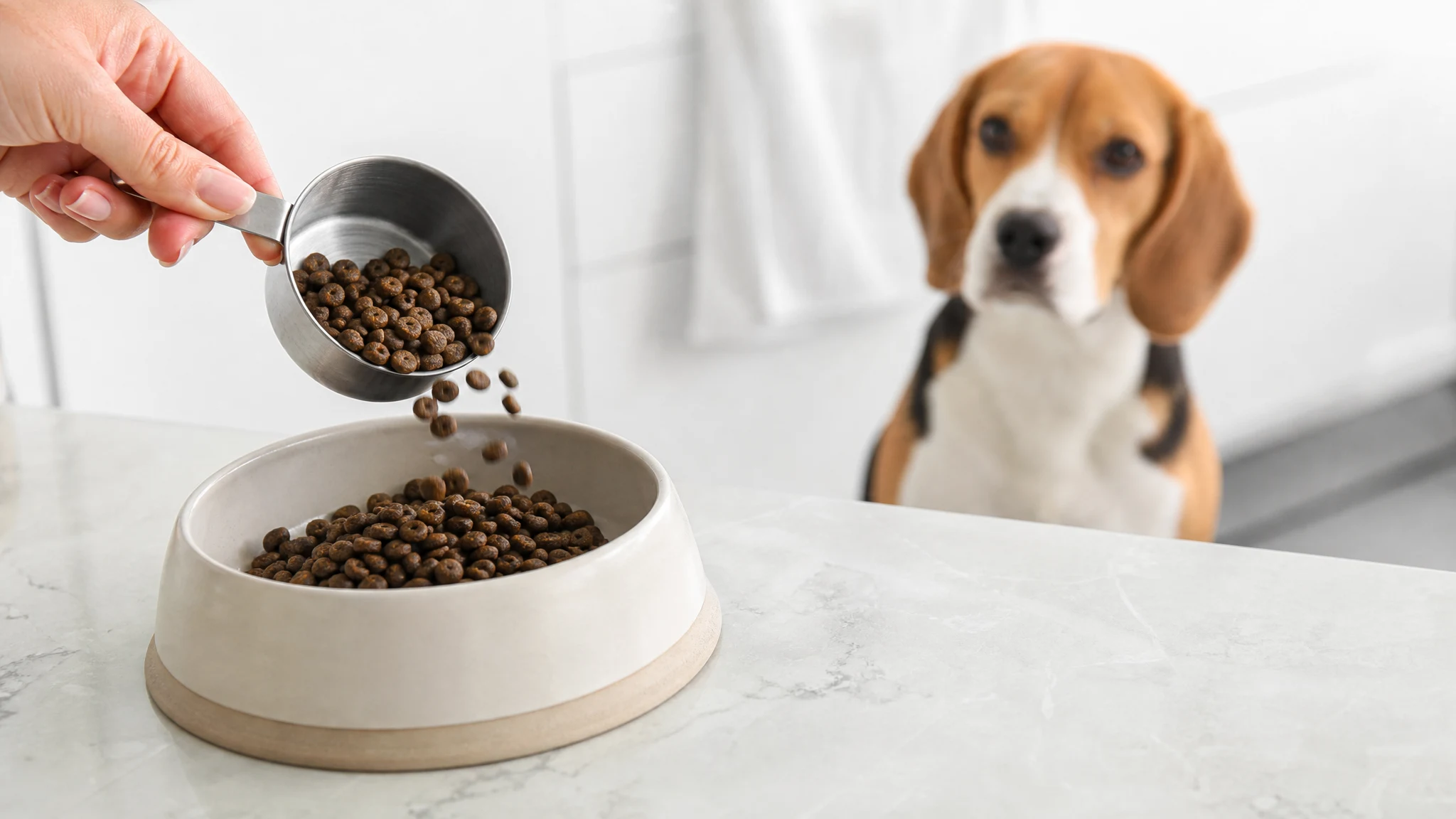
- Put the food in a bowl at mealtime and pick up what is left after a short while. Avoid leaving food out all day.
Royal Canin describes its Beagle kibble as shaped for the breed's square muzzle to encourage slower eating. Whether that helps your dog is something to watch for yourself.
Step 6: Check body condition
Body condition scoring is a hands-on check of fat cover and shape. Weight on the scale alone does not tell you whether a Beagle is lean, because frames differ. Ask your veterinarian to show you the scoring scale they use, and repeat the check at home every few weeks.
- Ribs: You should be able to feel them with light pressure, without a thick layer over them and without them sticking out sharply.
- Waist: Looking from above, there should be a visible narrowing behind the ribs.
- Belly: From the side, the belly should tuck up toward the back legs rather than hang level or sag.
- Chest and spine: Feel for a modest covering, not a thick pad of fat.
If you cannot feel the ribs or the waist has disappeared, your dog may be carrying extra weight. Talk to your veterinarian before cutting food sharply. PetMD also notes that hypothyroidism is common in Beagles and is managed with daily medication and weight monitoring, so a weight change is worth a veterinary check.
Step 7: Adjust for activity
Royal Canin's Beagle Adult table is split by activity level: low, medium and high. That shows brands expect two Beagles of the same weight to need different amounts.
- A dog that spends most days indoors with short walks may need less than the middle of the chart.
- A dog that hikes or runs regularly may need more.
- Change the amount in small steps and give it a few weeks before judging.
Re-weigh and re-check body condition after each change. Write down the date, weight and portion.
Step 8: Count treats and table scraps
Treats add calories that the label guide does not include. If you use food rewards for training, take them out of the day's meal portion. Reward-based training fits well with Beagles, since they are so food-motivated. Use small pieces, and measure part of the daily kibble as training rewards.
Tips for success
- Weigh your dog on the same scale every few weeks.
- Use a real measuring cup or a kitchen scale, not a scoop that came with another food.
- Keep a single feeding record that everyone in the house uses, so the dog is not fed twice.
- Use a slow-feeder bowl or a snuffle mat if your dog gulps. The effect varies by dog.
- Change foods gradually over several days unless your veterinarian says otherwise.
- Bring the food label and your notes to checkups.
Common mistakes to avoid
- Free-feeding. PetMD does not recommend it for Beagles.
- Feeding by the cup after changing brands. Calories per cup vary widely, as the table shows.
- Using the puppy amount for an adult. Puppy foods carry more calories per cup. For example, Royal Canin Medium Puppy is labeled at 410 kcal per cup against 284 kcal for Beagle Adult.
- Ignoring treats. Small extras add up for a dog prone to weight gain.
- Treating the chart as final. Brands themselves call these guides starting points.
- Switching to a grain-free or special diet on a hunch. The FDA's investigation into a possible link between certain diets and canine dilated cardiomyopathy was last updated December 23, 2022, and the FDA said it did not plan further public updates until there was meaningful new scientific information. Ask your veterinarian before choosing a diet on that basis.
- Using a prescription diet without a prescription. Those are something only a veterinarian prescribes.
What to expect
With steady measuring, a Beagle may hold a stable weight and keep a visible waist. Results vary with age, health, activity and the food chosen, and nothing here promises a particular outcome. If a dog is gaining or losing weight over a few weeks, adjust in small steps with your veterinarian's guidance.
PetMD gives the breed's life expectancy as 10 to 15 years, and Hill's lists 12 to 15 years. Individual dogs differ, and no feeding plan can promise a longer life.
When to call your veterinarian
Call if your dog refuses meals, loses or gains weight quickly, vomits, has loose stools, or seems lethargic. Ask before starting a weight-loss plan, a new diet for a health condition or any supplement. Your veterinarian can set a daily calorie target for your individual dog and confirm the right life-stage food.
Sources
- Hill's Pet Nutrition, Beagle breed page
- PetMD, Beagle breed page
- Royal Canin, Beagle breed library
- Royal Canin, Beagle Adult
- Royal Canin, Medium Adult
- Royal Canin, Medium Puppy
- Royal Canin, Medium Puppy thin slices in gravy
- Hill's Science Diet, Adult Perfect Weight
- Hill's Science Diet, Adult 7+ dry
- Hill's Science Diet, Puppy dry
- Hill's Science Diet, Adult 7+ Senior Vitality stew
- Freshpet, Roasted Meals Grain Free Chicken Recipe
- Merrick, Kitchen Comforts Real Chicken & Brown Rice
- Kentucky 12 KAR 3:039, Nutritional adequacy
- FDA CVM, Investigation into Potential Link between Certain Diets and Canine Dilated Cardiomyopathy