What the Beagle Breed Standard Says About Build and Health
General nutrition information compiled from product labels and published sources, not veterinary advice. Your veterinarian is the right person to choose a diet for your dog, especially one with a health condition.
A breed standard is a written description of a breed's ideal structure, proportions and temperament. It is maintained by the national breed club and used by conformation judges, not by pet food labels. The official Beagle breed standard, with exact height and structural detail, is published by the American Kennel Club and the National Beagle Club of America, and that is the right place to check for conformation specifics. This article does not reproduce that text. Instead, it walks through what veterinary and manufacturer sources publish about Beagle weight, growth and diet-relevant health, and how to turn those published numbers into a feeding plan you can actually follow.
What you will need
- A kitchen or pet scale, or access to a veterinary scale at checkups
- The feeding guide printed on your current dog food's label or bag
- A measuring cup you already use for kibble, not a scoop that came with a different bag
- A notebook, spreadsheet or phone note to track weight over time
- Contact information for your veterinarian, for anything specific to your dog
Step 1: Start with the published weight range, not a guess
Hill's Pet Nutrition's breed page lists adult Beagles at 18 to 30 pounds for both males and females. PetMD gives a slightly narrower range of 20 to 30 pounds, and Royal Canin's breed library lists a top adult weight of 30 pounds. No source we could verify assigns the Beagle an official AKC size category such as "small" or "toy," so this article does not use one. Treat the 18 to 30 pound spread as the range to compare your own dog against, understanding that an individual Beagle's correct weight depends on frame and body condition, not just the number on a label.
Step 2: Note when a Beagle is considered an adult
Royal Canin's Beagle Adult formula is labeled for purebred Beagles 12 months of age and older. That is useful as a practical marker: before 12 months, a Beagle is generally still being fed a puppy or growth product, and after that point a maintenance adult formula becomes appropriate. If you are unsure which stage your dog is in, ask your veterinarian rather than switching foods based on age alone.
Step 3: Check body condition, not just the bathroom scale
A number on a scale does not tell you whether a Beagle is lean, ideal or carrying extra weight, because frame size varies within the breed's range. Ask your veterinarian to show you how to check body condition by feel, at the ribs and waist, during a regular visit. Re-check it every few months, since the goal from Step 1 is a healthy individual dog, not a specific digit from a breed page.
Step 4: Understand why this breed tends toward extra weight
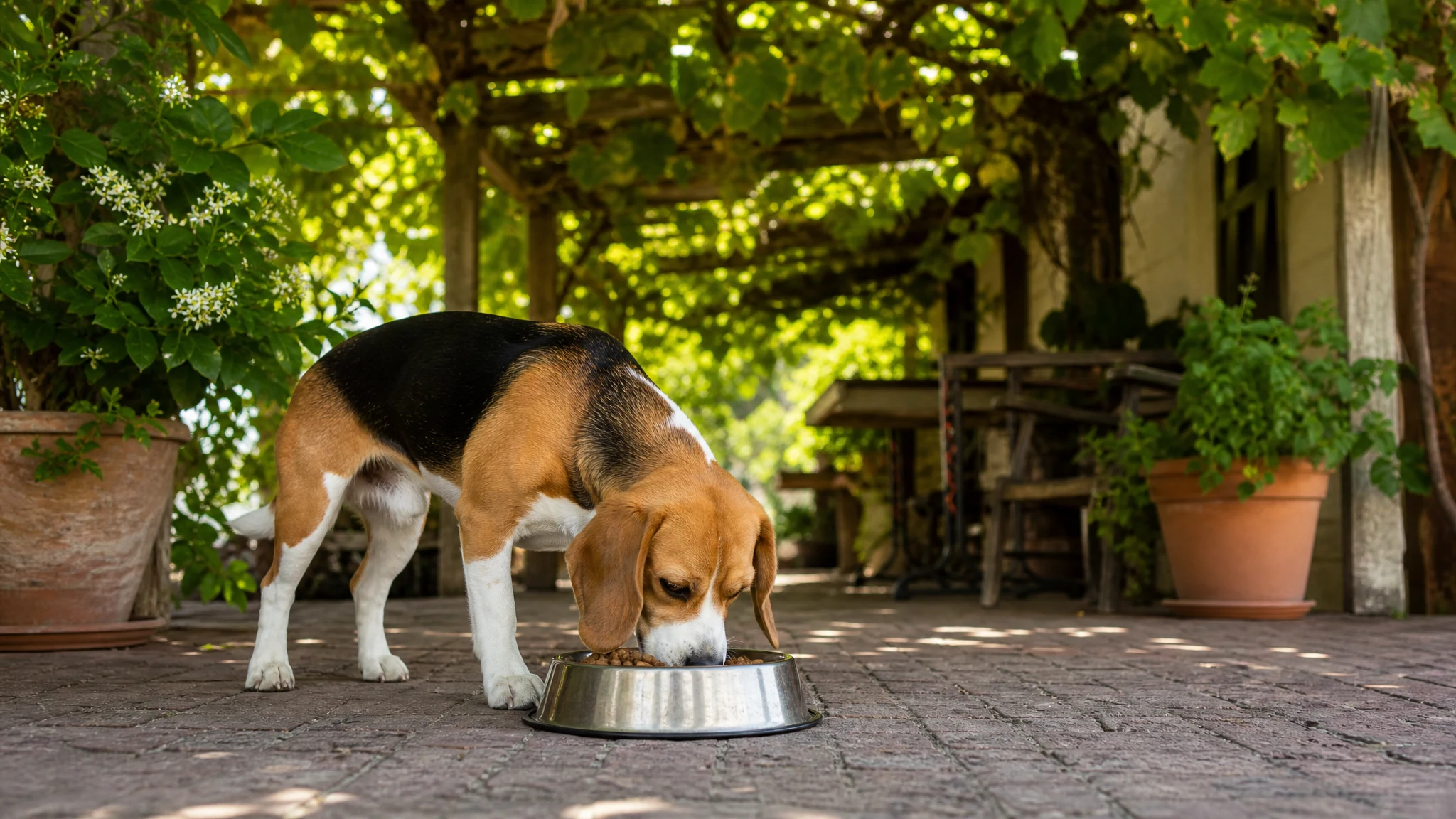
Hill's Pet Nutrition notes that some Beagles easily become overweight after puppyhood, so calorie intake is worth watching. PetMD describes obesity as very common in the breed and recommends feeding controlled amounts of a well-balanced commercial food across two to three meals a day rather than free-feeding. Royal Canin's breed library also lists Beagles as prone to obesity and names weight management as something that matters for the breed. None of these sources claim a particular food prevents or treats obesity. They describe a tendency and recommend portioned meals instead of a bowl that is always full.
Step 5: Use the label's feeding guide as a starting point, not a fixed rule
Every dog food label carries a feeding guide tied to body weight, and that guide is a starting point, not a guarantee of the right amount for your dog. Royal Canin's Beagle Adult page offers a daily feeding table by weight and activity level alongside a calculator, and its puppy products use a similar table by age and expected adult weight. Hill's product pages for its Adult, Adult 7+ and Puppy recipes each say to adjust feeding amounts as necessary to maintain optimal weight, and to ask your veterinarian if you are unsure. Start at the amount the label lists for your dog's weight, then adjust up or down over a few weeks based on the body condition check from Step 3.
Step 6: Watch for the other diet-relevant conditions named for this breed
PetMD lists intervertebral disc disease, hip dysplasia and patellar luxation as conditions Beagles may be susceptible to, and ties body weight, not a specific ingredient, to joint and spinal strain. PetMD also names hypothyroidism as common in the breed, managed with daily medication and weight monitoring under veterinary care. No source we reviewed claims any commercial food prevents, treats or cures these conditions, and this article makes no such claim either. If your Beagle has been diagnosed with any of these, a prescription diet is something only a veterinarian can prescribe, and ordinary feeding guides on a bag do not apply to that situation.
Step 7: Re-check the plan across the dog's expected lifespan
Hill's attributes a life expectancy of 12 to 15 years to the breed, while PetMD lists 10 to 15 years. Either way, a feeding plan set once at adulthood will not necessarily still fit a Beagle at seven or ten years old. Hill's markets separate recipes for adult maintenance and for dogs aged 7 and up, reflecting that calorie needs and body condition should be reassessed as a dog ages, in consultation with your veterinarian.
Common mistakes to avoid
- Relying on breed-page weight ranges as a diagnosis instead of a comparison point for your individual dog
- Free-feeding from a bowl that is always full, which PetMD specifically advises against for this breed
- Treating the label's feeding guide as fixed rather than as a starting point to adjust against body condition
- Assuming any commercial or grain-free food can prevent, treat or cure joint problems, DCM or hypothyroidism
- Switching a puppy to an adult formula before the life stage the label specifies, or the reverse
What to expect
Following a published weight range, a portioned feeding schedule and regular body-condition checks may help you keep a Beagle closer to a healthy weight over time, according to the obesity guidance in the sources above. This is not a guarantee, and results depend on the individual dog, its activity level and any underlying health condition a veterinarian is best placed to evaluate. For a closer look at how ingredients, protein and calorie density factor into choosing a food for this breed, see our guide on the diet factors that matter for Beagles.